

Exhaust gas turbocharging system
This system has been widely applied in vehicles on the market. Its principle is very simple. A turbocharger is added to the internal combustion engine. The high-temperature and high-speed exhaust gas discharged from the cylinder is supplied to the turbine of the turbocharger through the exhaust pipe, driving the turbine to rotate. The turbine then drives the impeller of the compressor on the same axis to rotate. The compressor compresses the intake air, and the air with increased pressure flows through the intake pipe of the internal combustion engine and is supplied to the cylinder, thereby achieving the purpose of supercharging.
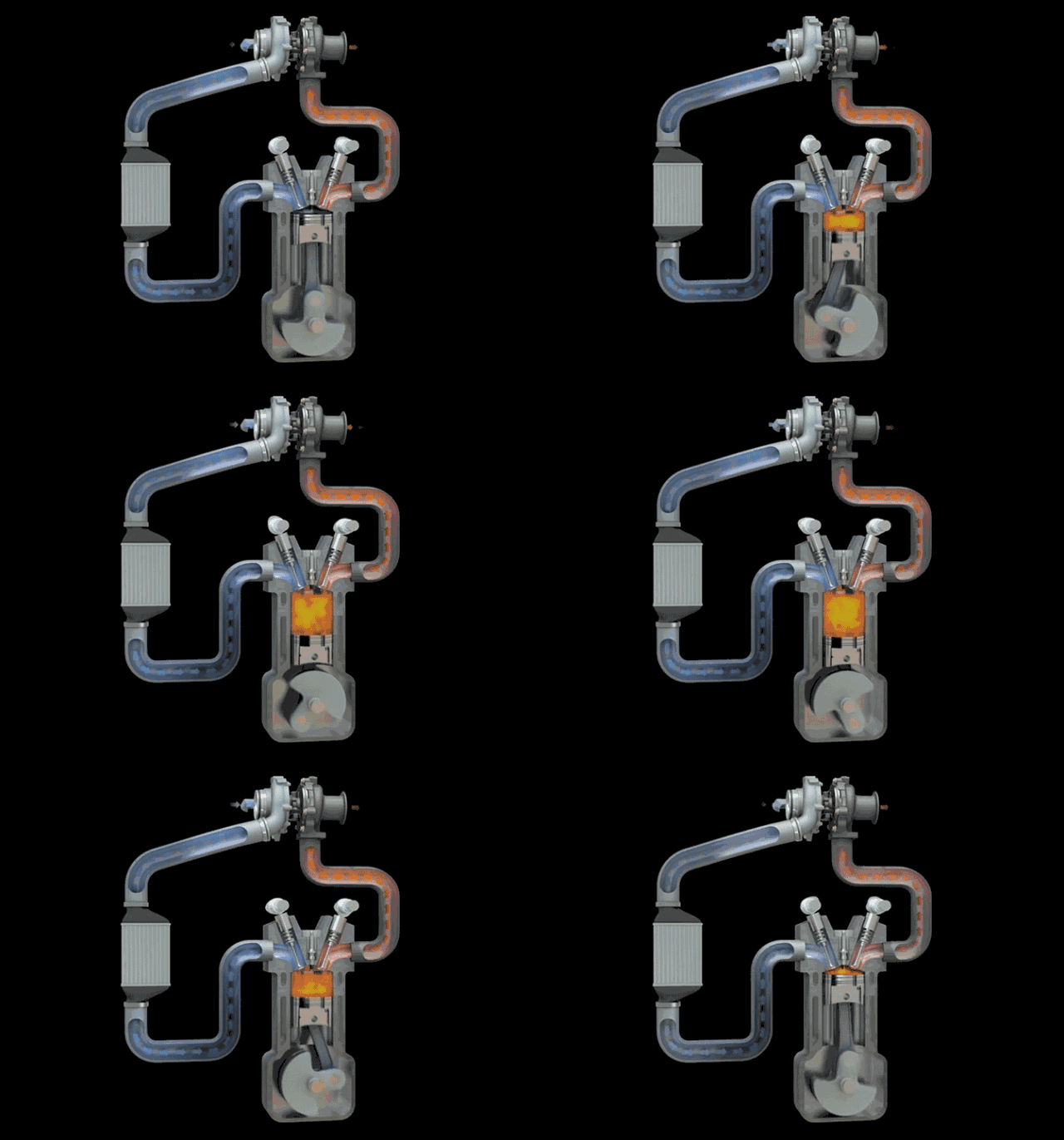
Advantages: It significantly improves the torque characteristics within the engine's speed range, enabling high power output at low torque. The reuse of exhaust gas can greatly reduce fuel consumption and carbon emissions.
Disadvantages: Due to the addition of a turbocharger and intercooler, there are relatively high design requirements for the engine structure. Moreover, the turbocharger is usually located on the hot side of the engine, which demands high material quality. Poor matching can easily lead to the phenomenon of turbo lag.
Mechanical supercharging system
In the high-speed range, naturally aspirated engines suffer from low intake efficiency. To address this issue, a mechanical supercharging device is added to the engine, which utilizes the torque generated by the engine's crankshaft to solve it. Early superchargers were all mechanical superchargers and can be regarded as the earliest boosting devices.Advantages: Mechanical supercharging completely resolves the issue of lag in throttle response. On this basis, it enhances the linear output of naturally aspirated engines, improving driving performance. Moreover, in terms of low-speed high torque and instant acceleration, mechanical supercharging technology outperforms turbocharging technology. It does not need to be connected to the engine's lubrication system, does not require cooling, is maintenance-free, reliable in operation, and has a long service life.
Disadvantages: Because it addresses the problem of air deficiency in the high RPM range, the actual acceleration effect on the vehicle is not very obvious. The mechanical supercharger is mainly driven by a belt, which causes a loss of some of the engine's kinetic energy. At high RPMs, it generates a lot of friction, affecting the increase in RPM and producing a lot of noise.
The gas wave supercharging system
By installing a gas wave supercharger inside the engine, the pulse gas waves of high-pressure exhaust gas are utilized to enable direct energy exchange between the exhaust and intake, forcing air compression to increase the intake density, thereby enhancing the engine's intake volume, achieving better combustion effects, and improving power.
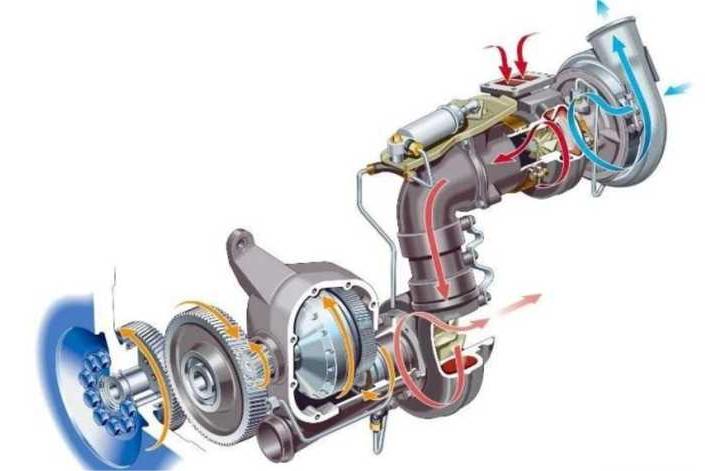
Advantages: The system principle is very simple and straightforward. Since the provided boost pressure varies little across the entire engine speed range and the energy conversion process is not affected by the rotor's inertia, the gas wave supercharger has excellent speed and load response characteristics.
Disadvantages: The structure is overly large in volume, imposing strict requirements on vehicle positioning and body shape. Moreover, it generates significant noise during operation and cannot effectively control exhaust emissions, thus not conforming to environmental protection concepts.