

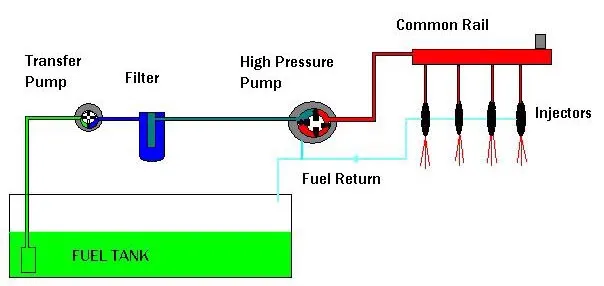
What does the high-pressure common rail do?
The high-pressure fuel pump lifts the fuel to the common supply line, where it is injected directly into the cylinder by controlling the injectors. The high-pressure common rail completely separates the injection process from the oil pressure generation, so that the supply pressure is not affected by the engine speed.
Advantages of high-pressure common rail:
- The injection pressure in the common rail system is flexibly adjustable to determine the optimum injection pressure required for different operating conditions, thus optimizing the diesel engine’s overall performance.
- The injection timing can be flexibly controlled independently, and together with the high injection pressure (120MPa-200MPa), NOx and particulate matter (PM) can be controlled at the same time within a small value to meet the emission requirements.
- Flexible control of the injection rate change, realizing the ideal injection law, easy-to-realize pre-injection, and multiple injection, not only reduce the NOx of diesel engines but also ensure excellent power and economy.
- By the solenoid valve control injection, control precision is higher, there will be no bubbles in the high-pressure oil circuit,t and the phenomenon of zero residual pressure, so in the range of diesel engine operation, the cycle of small changes in the amount of injection, uneven oil supply to the cylinders can be improved, thereby reducing the vibration of the diesel engine and reduce emissions.
Representative Car Models:
At the end of 1999, the Smart with a 3-cylinder common rail diesel engine was born, with a displacement of only 799mL, a maximum power of 30kW, and a maximum torque of 100Nm at 1800-2800rpm. Mercedes-Benz launched the E320 with a second-generation common rail engine, with a maximum power of 150kW/1000rpm and a torque of 250Nm, and 85% of the peak torque can be obtained at 1400rpm, and 500Nm of peak torque can be realized within a wide area from 1800 to 2600rpm. 85% of the peak torque can be obtained at 1400rpm, and a peak torque of 500Nm can be realized in a wide area from 1800 to 2600rpm. the acceleration time from 0 to 100km/h is only 7.7 seconds, and the top speed is 243km/h. the combined fuel consumption is 6.9L/100km, and the 80L fuel tank makes the range up to 1,000km. while the petrol-equipped The E320’s combined fuel consumption is 9.9L/100km.
Technical overview:
In diesel engines, high-speed operation so that the diesel fuel injection process time is only a few thousandths of a second, experiments have proved that in the injection process of high-pressure fuel pipe pressure in various places is with the time and location of the different changes. Due to the compressibility of diesel fuel and the pressure fluctuations of diesel fuel in the high-pressure fuel line, the actual state of injection and injection pumps specified by the plunger fuel supply law is significantly different. Pressure fluctuations in the fuel line sometimes also after the main injection, so that the pressure in the high-pressure fuel line rises again, to make the injector needle valve open the pressure, the needle valve has been closed and reopened to produce the second injection phenomenon, due to the second injection is not possible to complete combustion, thus increasing the smoke and hydrocarbon (HC) emissions, fuel consumption increases. In addition, the residual pressure in the high-pressure fuel line will change after each injection cycle, resulting in unstable injection, especially in the low-speed region that is prone to the above phenomenon, and when it is serious, not only uneven injection but also intermittent non-injection phenomenon. To solve this defect of diesel engine fuel pressure change, modern diesel engine adopts a kind of technology called common rail.
High-pressure common rail technology refers to a closed-loop system composed of the high-pressure fuel pump, pressure sensor, and ECU, the generation of injection pressure and the injection process are completely separate from each other, a fuel supply method, by the high-pressure fuel pump to deliver high-pressure fuel to the common fuel supply pipe, through the – on the common fuel supply pipe in the oil pressure to achieve precise control, so that the size of the high-pressure fuel pipe pressure is independent of the engine’s rotational speed, which can significantly reduce the diesel engine fuel supply pressure The ECU controls the injection volume of the injector, which depends on the pressure of the fuel rail (common fuel supply pipe) and the duration of the opening time of the solenoid valve.
Principle of Common Rail Technology
The high-pressure common rail system is mainly composed of an electronic control unit, a high-pressure fuel pump, a pressure accumulator (common rail pipe), an electronically controlled injector, and various sensors. The low-pressure fuel pump will fuel the high-pressure oil pump, the high-pressure oil pump will fuel pressurized into the high-pressure oil rail (accumulator), high-pressure oil rail pressure by the electronic control unit according to the oil rail pressure sensor measurement of the rail pressure and the need to regulate the high-pressure oil rail fuel through the high-pressure oil pipe, according to the machine’s operating conditions, by the electronic control unit to determine the appropriate fuel injection timing, fuel injection duration of the electro-hydraulic control of the electronic fuel injector The fuel is injected into the cylinder.