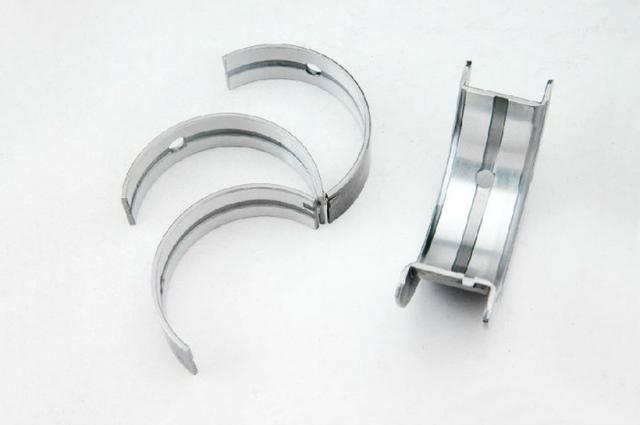
The bearing bush is the part where the sliding bearing and the shaft neck come into contact. It is shaped like a semi-cylindrical surface with a wavy form and is very smooth. It is generally made of wear-resistant materials such as bronze, anti-friction alloys, etc. In special cases, it can be made of wood, engineering plastics or rubber.
There are two types of bearing shells: integral type and split type. The integral type bearing shells are usually called bearing sleeves. There are two types of integral bearing shells: those without oil grooves and those with oil grooves. The bearing shells and the shaft neck are in clearance fit, and they do not rotate with the shaft.
When a sliding bearing is in operation, a very thin oil film is required to be formed between the bearing bush and the rotating shaft for lubrication. If the lubrication is poor, direct friction will occur between the bearing bush and the rotating shaft. This friction will generate extremely high temperatures. Although the bearing bush is made of special high-temperature-resistant alloy materials, the high temperatures resulting from direct friction are still sufficient to damage it. The bearing bush may also be damaged due to excessive load, excessively high temperature, impurities in the lubricating oil, or abnormal viscosity. After the bearing bush is damaged, the sliding bearing is damaged.
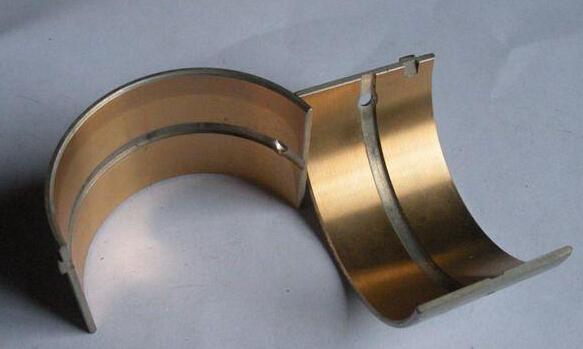
For rolling bearings operating under sliding friction, they are stable, reliable and noise-free during operation. Under the standard of liquid lubrication, the surface layer is separated by the lubricating grease without immediate contact, which can greatly reduce friction damage and surface layer damage. The oil film also possesses the necessary vibration absorption working ability.
However, the friction generated during startup is quite significant. The part of the rolling bearing support plate that supports the shaft is called the journal, and the corresponding component that matches the journal is called the bearing bush. In order to improve the friction characteristics of the surface layer of the bearing bush, the layer of friction-reducing raw material cast on its inner surface is called the rolling bearing liner. The raw materials of the bearing bush and the rolling bearing liner are collectively referred to as rolling bearing raw materials. Common rolling bearing raw materials include bearing alloys (also known as Babbitt alloys or white aluminum alloys), wear-resistant cast iron, copper-based and aluminum-based alloys, powder metallurgy materials, plastics, vulcanized rubber, rosewood and carbon-high-purity graphite, PTFE (PTFE), modified polyoxymethylene (POM), etc.
The application places of rolling bearings are usually in situations where the load is heavy and the speed is low, or in locations where maintenance and lubrication are difficult. A rolling bearing is usually composed of an outer ring, an inner ring, a rolling body and a cage. At least the inner ring functions to fit with the shaft and rotate together with the shaft, while the outer ring functions to support the shaft seat bearing and provide a supporting point function. The rolling body is evenly distributed by the cage across the outer ring and the space between the outer ring through the cage, and its shape, size and total number immediately affect the performance indicators and service life of the rolling bearing. The cage enables the rolling body to be uniformly distributed, avoids the rolling body from falling off, and correctly guides the rolling body to rotate for lubrication.

Roller bearings are convenient for application maintenance and operation. They are reliable during operation and have good starting characteristics. They have high bearing capacity at medium-speed rates. Compared with rolling bearings, roller bearings have a larger axial specification, weaker shock absorption ability, and shorter service life at high speeds, and produce louder noise. The radial bearings in roller bearings (which mainly bear axial forces) are generally composed of inner ring, outer ring, rolling body and rolling body cage.
The inner ring is tightly fitted onto the journal and rotates together with the shaft. The outer ring is fitted into the bearing housing bore. On both the outer periphery and the inner periphery of the outer ring, raceways are machined. When the inner and outer rings rotate relative to each other, the flip body flips over on the raceways of the outer ring. They are separated by the cage to prevent mutual friction. Thrust bearings are divided into two parts: the fixed ring and the floating ring.
The inner ring is tightly fitted with the shaft sleeve, and the support plate of the outer ring is on the bearing housing. The rings and the flip body are generally manufactured from roller bearing steel with high compressive strength and good wear resistance. After heat treatment, the surface strength should exceed HRC 60-63. The cage should be made by stamping with soft steel molds, or it can be manufactured from alloy copper cloth-bonded wood or plastic, etc. The difference between roller bearings and rolling bearings lies in the first thing in essence, which is in the structure. Roller bearings support the rotating shaft by the rotation of the flip body, so the contact position is a point. The larger the flip body is, the more contact points there are; rolling bearings support the rotating shaft by a linear surface, so the contact position is a surface.
The second difference lies in the movement methods. The movement method of roller bearings is flipping; that of rolling bearings is dragging. Therefore, the frictional methods are completely different. When the application time of the equipment is long and new bearing shells need to be replaced, in order to achieve a very good mutual cooperation between the bearing shells and the shaft necks, the inner surface of the bearing shells should be scraped with scraper to ensure a large total contact area between the bearing shells and the shaft necks.、