

Four-stroke engine (oil gas)
Main types: in-line engine, V-type engine, W-type engine, horizontal opposed engine, rotor engine.
The working principle of an engine
Gasoline engine:
A four-stroke gasoline engine mixes air and gasoline in a certain proportion to form a good mixture, which is drawn into the cylinder during the intake stroke. The mixture is compressed, ignited and burned to generate thermal energy. The high-temperature and high-pressure gas acts on the top of the piston, pushing the piston to move back and forth in a straight line. Through the connecting rod, crankshaft and flywheel mechanism, mechanical energy is output to the outside. A four-stroke gasoline engine completes a working cycle within the intake stroke, compression stroke, power stroke and exhaust stroke.
Diesel engine:
The working process of a diesel engine is actually not much different from that of a gasoline engine. Each working cycle also goes through four strokes: intake, compression, power, and exhaust.
The working principle of the transmission
The manual transmission is mainly composed of gears and shafts, generating different speeds and torques through different gear combinations; while the automatic transmission (AT) is composed of a hydraulic torque converter, planetary gears and a hydraulic control system, achieving speed and torque changes through hydraulic transmission and gear combinations. The manual transmission is also known as the manual gearbox (abbreviated as MT) or mechanical gearbox, meaning that the gearshift lever (commonly known as the "gear stick") must be manually operated to change the gear meshing position inside the transmission, altering the transmission ratio and thus achieving the purpose of speed change.
The working principle and types of clutches
The clutch is located inside the flywheel housing between the engine and the transmission. The clutch assembly is fixed to the rear plane of the flywheel with screws, and the output shaft of the clutch is the input shaft of the transmission. During vehicle operation, the driver can step on or release the clutch pedal as needed to temporarily separate or gradually engage the engine and the transmission, thereby cutting off or transmitting the power input from the engine to the transmission.
The differential works (planetary gear)
The automotive differential is a mechanism that enables the left and right (or front and rear) drive wheels to rotate at different speeds. It mainly consists of left and right half shaft gears, two planetary gears, and a gear carrier. Its function is to ensure that the left and right wheels roll at different speeds when the car is turning or driving on an uneven road surface, that is, to guarantee that the two drive wheels on both sides perform pure rolling motion. The differential is installed to adjust the speed difference between the left and right wheels.
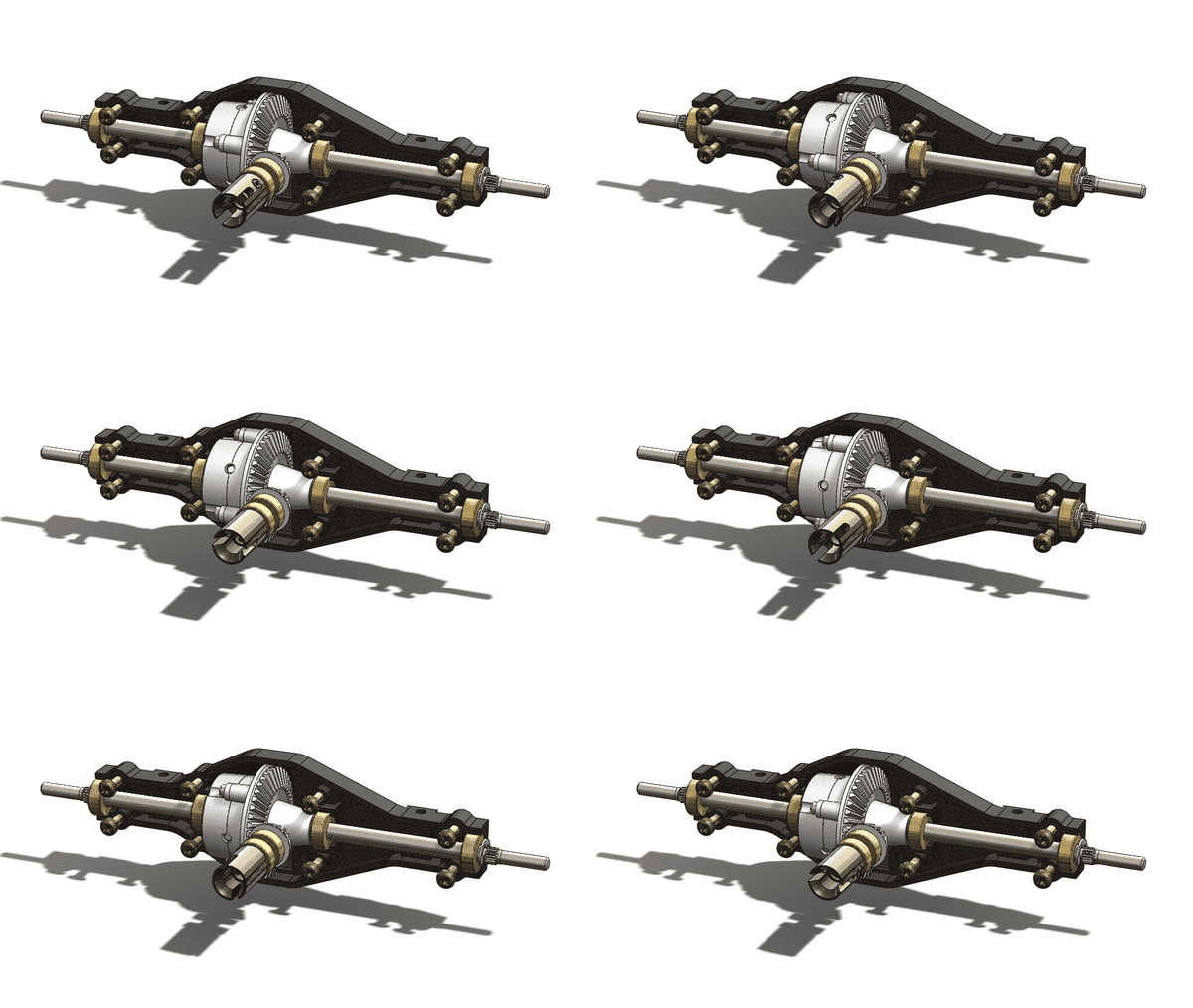
Planetary gear
Planetary gears refer to a gear system in which, in addition to being able to rotate around their own axes like fixed-axis gears, their axes also rotate along with the planet carrier around the axes of other gears. Rotation around their own axes is called "self-rotation", and rotation around the axes of other gears is called "revolution", just like the planets in the solar system, hence the name.
Two-stroke engine:
First stroke: As the piston moves upward from the bottom dead center, the three ports are simultaneously closed, and the mixture that has entered the cylinder is compressed; when the intake port is exposed, the combustible mixture flows into the crankcase.
Second stroke: When the piston is compressed near the top dead center, the spark plug ignites the combustible mixture, and the expanding gas pushes the piston down to do work. At this time, the intake hole is closed, and the combustible mixture sealed in the crankcase is compressed; when the piston approaches the bottom dead center, the exhaust hole opens, and the exhaust gas rushes out; then the exchange hole opens, and the pre-compressed combustible mixture rushes into the cylinder, driving out the exhaust gas while the exchange process is carried out simultaneously.